CASAA Is Folding

Dear Members,

Last July, CASAA reached out to our members and allies with an urgent plea for funding. We spent the summer and into the fall approaching potential donors, but fell short of our goal. In turn, CASAA continued cutting costs to the point that we were no longer able to support our small staff of two paid employees. Since August of 2024, CASAA is completely run by volunteers. We have secured funding to enable us to continue our legislative advocacy efforts until August of this year. But beyond that, we do not expect enough future support to continue in any meaningful way.

It is with mixed emotions that we are taking this opportunity to announce that 2025 will be CASAA’s last year of active engagements. While we will be ceasing our legislative advocacy at the end of August, our website, CASAA.org, remains a valuable educational resource documenting the history of vaping, explaining tobacco harm reduction, and celebrating the consumer-led revolution in adoption of safer nicotine products. CASAA will use some of our remaining funds to keep the website active, although we anticipate transforming it into a legacy site. This means that information contained on the site will be pared down so that the site will require little maintenance.

Although we have gratefully received feedback from fellow advocates and industry leaders praising our efforts and noting the significance of our role in the consumer-led tobacco harm reduction movement, those accolades are rarely accompanied by financial support. For the better part of a decade, CASAA has articulated this dissonance by saying that it is absolutely appropriate for businesses to devote most or all of their advocacy budget to state and national trade groups.

While industry support has made up a significant portion of our funding, it was never expected that shops and manufacturers would pay for everything. Being supported by our consumer membership has allowed us to remain independent in our policy positions and advocacy messages that support affordable and legal access to safer alternatives to smoking. But that independence is fragile, and we experienced the consequences from bucking the narrative of the largest tobacco companies when we opposed policies that ban sales of unauthorized products — products that still make up more than 90% of the safer nicotine market.

Since 2009, CASAA has been a tireless voice of and for consumers who switched away from combustion to safer, smoke-free nicotine products. We have done this work on a shoestring, which is a testament to the power of our stories. CASAA has represented our members in city halls, state legislatures, and federal regulatory bodies, as well as shared the consumer view at professional conferences and in the media. We have brought to our work the heart and soul that only comes from genuine grassroots advocacy. Consmers are being recognized as a vital part of the debate over the responsible regulation of less risky tobacco and nicotine products, which is a pillar of CASAA’s mission.

We are not making this announcement from a place of desperation or futility. This is not the end, but merely a step in the evolution of consumers’ awareness, acceptance, and access to safer nicotine products and a healthier future.

Thank you for standing up for tobacco harm reduction!

Sincerely,

Alex Clark, Executive Director, CASAA

The Consumer Advocates for Smoke-Free Alternatives (CASAA)
PO Box 2991, | Plattsburgh, New York 12901
Question? Email us at takeaction@casaa.org or call 202-241-9117


Take the 2024 Vaper Survey!

Since 2016 CASAA has been working cooperatively with ECigIntelligence, an independent information service focused on tracking regulatory change and market intelligence for the vape sector. CASAA assists them with their annual U.S. survey of adults who vape by helping them develop survey questions that aid us in our advocacy efforts and help take the pulse of the vaping community.

As we do every year, CASAA is asking our members to participate in this year’s survey with the goal of collecting 5000 responses!

Take the Survey!

WHY SHOULD YOU PARTICIPATE?
The data collected from this survey will help inform regulators, advocates, and commentators as we all work to build policies that benefit consumers. The FDA in particular subscribes to this dataset and it can therefore serve as direct feedback on how their policies benefit or harm people who vape.

WHAT KIND OF QUESTIONS WILL YOU BE ASKED?
The survey takes about 10-15 minutes to complete, and will ask you a range of questions starting with general demographic information like your age, gender, race, what state you live in, and your household income. Only a few of these demographic questions are required, however, so you can skip any you’d prefer not to disclose. After that you’ll answer a range of questions about your history of tobacco and vapor product use. The survey is anonymous, and none of the information provided can or will be used to personally identify you. You have the option of supplying your email at the end of the survey if you’d like to receive a summary of the results.

WHO CAN PARTICIPATE IN THE SURVEY?
Adults over the age of 21 living in the United States who currently use or previously used vapor and tobacco products are encouraged to participate.

HOW ELSE CAN YOU HELP?
After you’ve completed the survey, or if you are disqualified from participating but still want to help, please encourage your friends and family to participate! The goal of the survey is 5,000 respondents minimum, so every person helps!

Thank you for standing up for tobacco harm reduction,

Alex Clark
CEO, CASAA

Take The Survey!

Since 2016 CASAA has been working cooperatively with ECigIntelligence, an independent information service focused on tracking regulatory change and market intelligence for the vape sector. CASAA assists them with their annual U.S. survey of adults who vape by helping them develop survey questions that aid us in our advocacy efforts and help take the pulse of the vaping community.

As we do every year, CASAA is asking our members to participate in this year’s survey!

Take the Survey!

WHY SHOULD YOU PARTICIPATE?
The data collected from this survey will help inform regulators, advocates, and commentators as we all work to build policies that benefit consumers. The FDA in particular subscribes to this dataset and it can therefore serve as direct feedback on how their policies benefit or harm people who vape.

WHAT KIND OF QUESTIONS WILL YOU BE ASKED?
The survey takes about 10-15 minutes to complete, and will ask you a range of questions starting with general demographic information like your age, gender, race, what state you live in, and your household income. Only a few of these demographic questions are required, however, so you can skip any you’d prefer not to disclose. After that you’ll answer a range of questions about your history of tobacco and vapor product use. The survey is anonymous, and none of the information provided can or will be used to personally identify you. You have the option of supplying your email at the end of the survey if you’d like to receive a summary of the results.

WHO CAN PARTICIPATE IN THE SURVEY?
Adults over the age of 21 living in the United States who currently use or previously used vapor and tobacco products are encouraged to participate.

HOW ELSE CAN YOU HELP?
After you’ve completed the survey, or if you are disqualified from participating but still want to help, please encourage your friends and family to participate! The goal of the survey is 5,000 respondents minimum, so every person helps!

Take the Survey!

Thank you for standing up for tobacco harm reduction,

Alex Clark
CEO, CASAA

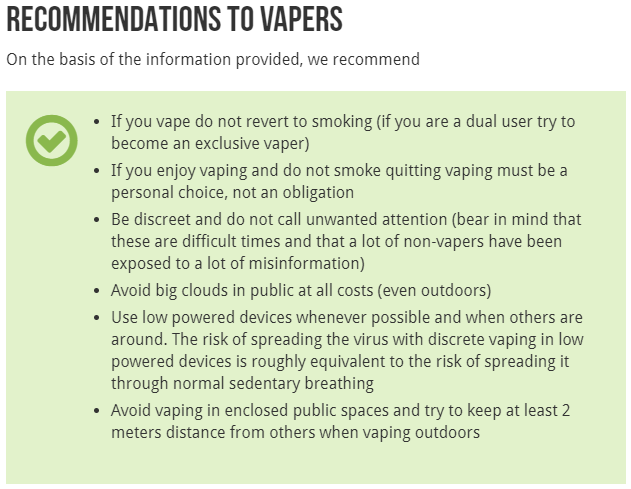
CASAA Recommendations…

covid-19 - recommendations to vapers (sussman) - 03_24_20.png

Written by Roberto Sussman1 and Carmen Escrig2
1Institute for Nuclear Sciences, National University of México UNAM. Physics PhD. Director of Pro-Vapeo México AC
2Universidad Autónoma de Madrid, Spain. Biology PhD specialized in Virology. Coordinator of the Medical Platform for Tobacco Harm Reduction in Spain.

Summary

PURPOSE The spread of the SARS-CoV-2 pandemic provides fertile ground for spreading misinformation on vaping. Vapers must be equipped with solid information and data to counterargue.

ON SMOKING. The relation between smoking and the progression to severe conditions of COVID-19 is still uncertain, though identified vulnerability conditions for this progression (cardiovascular and respiratory disease, diabetes) in mostly senior patients are strongly correlated with long term harms from smoking.

ON VAPING. There is no evidence that vaping (intrinsically) increases the risk of infection or progression to severe condition of COVID-19. When evaluating risks on vapers it is necessary to consider that most are ex-smokers or still smokers. Vapers with a long previous smoking history could exhibit conditions seen in vulnerable patients. However, this would not be an effect of vaping but of previous smoking. Since completely switching from smoking to vaping improves cardiovascular and respiratory conditions, smokers who switch to vaping are expected to have a better prognosis if infected by SARS-CoV-2

ON PROPYLENE GLYCOL (PG) AS DISINFECTANT. Because of its hygroscopic nature PG vapor (not droplets) can act as environmental disinfectant wiping out pathogens under specific physical conditions. However, there is no evidence on whether this effect will work on SARS-CoV-2 and in the context of vaping.

ON ENVIRONMENTAL VAPOR. While there are no reported and verified cases of contagion, the saliva droplets carrying SARS-CoV-2 virus are much heavier than the rapidly moving volatile droplets of exhaled vapor. Therefore, vapor exhaled by an infected vaper is likely to spread as much viruses as in normal respiration in the personal breathing zone, far less and far closer than spreading by sneezing or coughing.

More info here

From the CEO…

casaa-color-logo-high-res.jpg

“As expected, reports of people being hospitalized due to a “mystery lung disease” continue to grow. The non-communicable lung disease that is increasingly being linked to products such as K2/Spice and/or adulterated THC cartridges–sold by underground sellers–is now under investigation in 22 states including CA, CT, FL, IL, IN, IA, MN, MI, NC, NJ, NM, NY, PA, TX, UT, WI, and as of Thursday, Colorado has its first confirmed case.

As of Friday morning, one death in Illinois is being attributed to an unknown substance that people are consuming by way of vaping. CASAA extends our condolences to the family and share in everyone’s disappointment in knowing that this tragic death could have been prevented if more compassionate policies were in place.

In last week’s Heads Up Round Up we briefly highlighted the concern that state and federal drug policy is complicating diagnosis, patient care, and accurate reporting about these clusters of lung disease. But in the wake of these reported illnesses, almost all of the usual anti-tobacco campaigners are using this event to elevate their cries for an all-out ban on nicotine vaping products–especially e-liquids sold in flavors other than tobacco.

Anti-tobacco campaigners are advocating for policies that will do absolutely nothing to prevent events like this in the future. Rather, it is more likely that heavy regulation–even if it isn’t total prohibition–will lead to more instances of people being harmed by fake pot, adulterated THC, or poorly manufactured nicotine products sold on an unregulated, illicit market. According to an article on TechCrunch, the FDA is still uncertain if the products being used even fall under the agency’s regulatory authority.

CASAA is reaffirming our advice to consumers that vapor products (THC and nicotine) should be purchased from reputable sources and not “on the street.” We also note that the terminology used to discuss this issue can benefit from including a clear distinction between nicotine vaping, THC/cannabis vaping, and synthetic cannabinoid vaping (k2/spice). Simply reporting that a mysterious lung disease is generally attributable to “vaping” will have harmful unintended consequences such as sending people back to combustible tobacco or discouraging them from making the switch at all.”

Stay safer,

Alex Clark, CEO
CASAA